Fact box
- Trails covered: Prime Hook Boardwalk Trail (0.55 mi loop), Prime Hook Dike Trail (0.49 mi one-way), Trap Pond American Holly Trail (0.7 mi), Cape Henlopen Bike Loop (3.8 mi), Georgetown-Lewes Trail (11 mi open / 17 mi when complete)
- Surfaces: boardwalk, hard surface, crushed stone, asphalt
- Difficulty: all rated easy or flat in official/trail-database sources
- Parking and fees: Prime Hook has no entrance fee; state park trails require a Delaware State Parks vehicle pass. Current rates at destateparks.com
- Restrooms: at the Prime Hook visitor center, Trap Pond Baldcypress Nature Center, Cape Henlopen Seaside Nature Center, and the Georgetown-Lewes Monroe Avenue trailhead
- Dogs: allowed on all five trails (leash rules vary by site)
- Official sources: USFWS Prime Hook trails page · TrailLink American Holly · TrailLink Cape Henlopen Bike Loop · Delaware Greenways Georgetown-Lewes Trail
- Last verified: 2026-06
Sussex County has more accessible outdoor routes than most visitors realize, spread across a wildlife refuge, two state parks, and a rail-trail corridor.
Five trails stand out: flat, hard-surfaced, and documented as accessible or stroller-friendly by the agencies that manage them.
This guide covers each one with practical details on surface, fees, restrooms, and the caveats you need to know before you go.
The two shortest routes: Prime Hook National Wildlife Refuge
Prime Hook is the easiest entry point for accessible outdoor walking in Sussex County. No entrance fee, open year-round, and two of its trails carry the USFWS’s own “wheelchair accessible” designation on the official trails page.
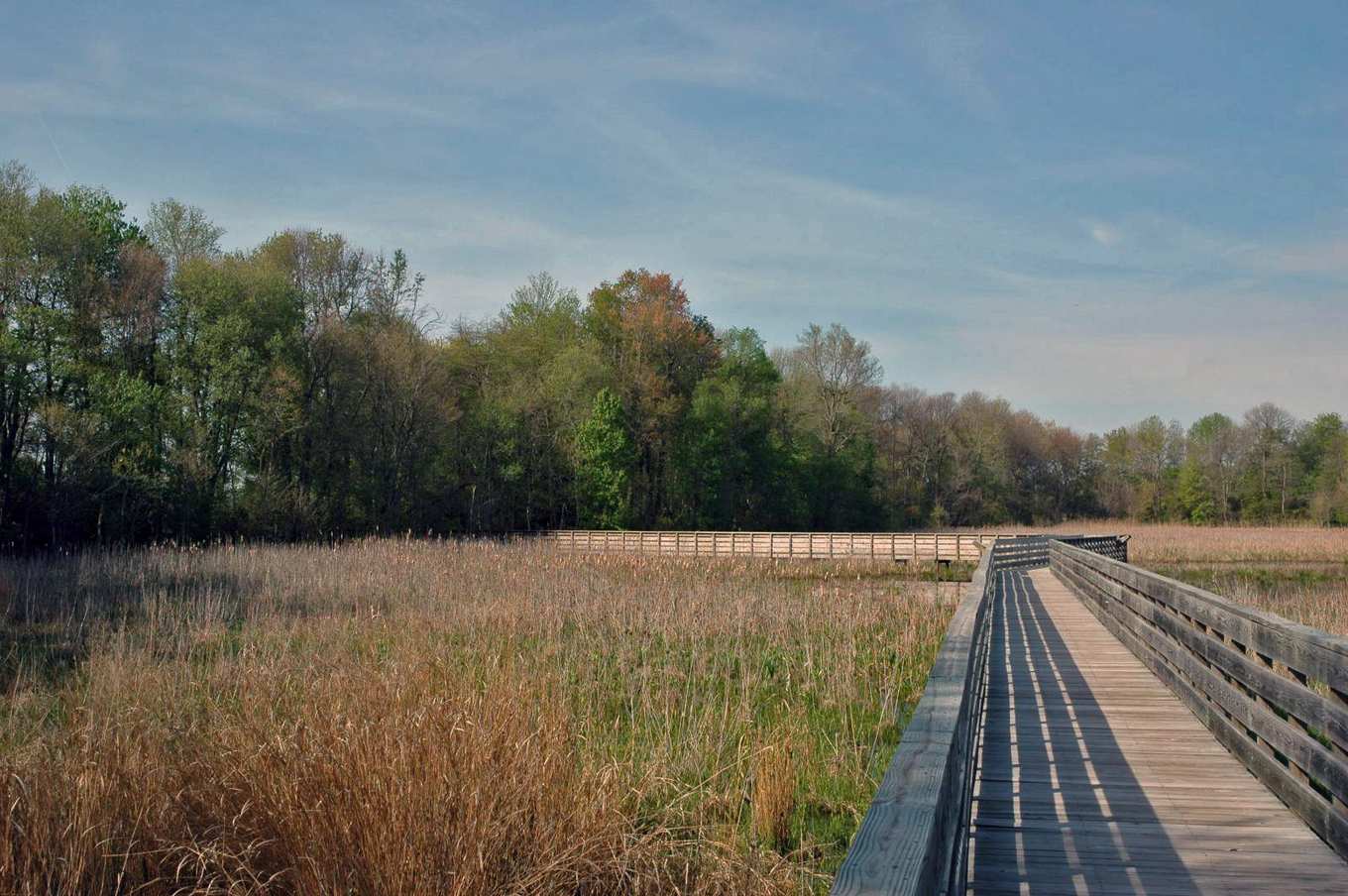
The Boardwalk Trail is a 0.55-mile loop through uplands and forested wetlands, crossing 600 feet of freshwater marsh on boardwalk. The loop format means no retracing and a clear turnaround point.
USFWS describes it as “0.5 mile” in its trail text; the data table gives 0.55 miles. Both figures come from the same page.
The Dike Trail covers 0.49 miles one-way on a hard surface to a wheelchair-accessible observation platform overlooking the marsh. Wildlife observation and photography are the draw here.
A practical note on the “wheelchair accessible” label at Prime Hook: the designation comes from USFWS itself, applied to these two trails specifically among the refuge’s six. No formal ADA certification language appears on the fetched pages, but the designation is the refuge’s own, not an informal third-party claim.
The visitor center at refuge headquarters is also wheelchair accessible and open daily year-round from 9am to 4pm, weather and volunteer dependent. Parking is available at the headquarters area.
One caveat matters regardless of season: USFWS warns of heavy mosquitoes, ticks, and biting flies from June through September. Early morning visits and insect protection are worth planning for if you’re going in summer.
Trap Pond: a flat 0.7-mile spur on crushed stone
The American Holly Trail at Trap Pond State Park runs 0.7 miles from the Baldcypress Nature Center to a junction with the longer Bob Trail. TrailLink describes it as flat on crushed stone and lists it under wheelchair accessible activities.
The trail passes through loblolly pine, baldcypress, and American holly. Trap Pond holds the northernmost natural stand of bald cypress in the eastern United States, and the nature center sits at the edge of it.
The Baldcypress Nature Center is closed Mondays and Tuesdays. Parking and restrooms are available there when it’s open. A state park entrance fee applies to access the parking area.
The flat crushed stone surface is well-suited for strollers and manual wheelchairs on a dry day. The Bob Trail at the far end is a different story: a 4.5-mile loop on crushed stone and boardwalk bridges over the swamp. That trail is covered in the Bob Trail and Trap Pond guide.
Cape Henlopen Bike Loop: mostly flat, mostly paved, with two exceptions
The 3.8-mile paved loop at Cape Henlopen State Park is the longest accessible-category route near the beach. TrailLink classifies it as wheelchair accessible, and most of the route is level asphalt and concrete.
Two steep sections are the exception. TrailLink identifies one on the approach to Fort Miles Historic Area and one just west of the campground. For powered wheelchairs these may be manageable; for manual chairs or heavily-laden strollers, they’re worth knowing about in advance.
Parking and restrooms are at the Seaside Nature Center at the trailhead. Additional restrooms are at the bathhouse 0.5 miles east of the nature center. A state park entrance fee applies.
The loop passes Fort Miles, a WWII coastal defense installation, and Fire Control Tower 12. Dog limits at Cape Henlopen are seasonal and apply to the swimming beaches, not this paved loop.
Verified beats vivid: we’d rather be accurate than poetic.
That’s why the two steep sections get a mention here and not buried in the fine print.
The Cape Henlopen Bike Loop connects northward to the Gordons Pond Trail. That trail mixes crushed stone and boardwalk over about 3.2 miles and is covered in the full Gordons Pond guide.
Georgetown-Lewes Trail: the longest flat route in the county
The Georgetown-Lewes Trail is the county’s best option for distance on a hard, flat surface. Delaware Greenways rates it easy and describes a “relatively flat route” on asphalt following the former Delaware Coast Line Railroad bed. TrailLink lists it as wheelchair accessible as an activity category.
As of 2024, 11 miles are open across three segments: a 0.9-mile segment in Georgetown and two adjacent segments near Lewes. When the final section connects, the trail will run 17 miles between Georgetown and Lewes.
The Monroe Avenue trailhead in Lewes has ample parking, restrooms, a water bottle filling station, a bike repair station, and an informational kiosk, according to Delaware Greenways. The Lewes Public Library near the eastern end adds another access point with parking, restrooms, and benches.
There are 12 at-grade road crossings along the 8-mile Lewes-to-Georgetown span. These are a meaningful consideration for independent wheelchair users; the crossings are marked, but each one interrupts the paved surface.
TrailLink and Delaware Greenways both describe the trail as wheelchair accessible, but neither source uses formal ADA designation language. The trail is free to use; no entrance fee applies.
At the Lewes end, the trail connects to the Junction & Breakwater Trail at Gills Neck Road, which extends the network toward Rehoboth Beach.
Seasonal notes
All five trails are open year-round with no seasonal closure of their own.
Prime Hook carries the strongest seasonal caveat. Bug season from June through September is documented by USFWS, and the refuge sits in the middle of a marsh system. Early morning visits, long sleeves, and insect repellent matter more here than at the paved trails.
The Trap Pond nature center closure on Mondays and Tuesdays affects access to the parking area and restrooms for the American Holly Trail. There’s no gap in trail access itself, but the facilities situation changes on those days.
The Georgetown-Lewes Trail is fully exposed in sections. Summer heat on the open stretches is worth planning around, especially on a route long enough to take an hour or more.
Shoulder seasons are the practical answer for most of these trails. Spring and fall bring fewer crowds, more comfortable temperatures, and at Prime Hook specifically, better birding.
Frequently asked questions
Which trails at Prime Hook are wheelchair accessible?
Two of Prime Hook’s trails carry the USFWS’s own wheelchair accessible designation: the Boardwalk Trail (0.55-mile loop) and the Dike Trail (0.49 miles one-way). Both are documented on the USFWS trails page. The rest are on natural surfaces and are not listed as accessible.
Is there a fee to use these trails?
Prime Hook National Wildlife Refuge charges no entrance fee. The Georgetown-Lewes Trail is also free.
The American Holly Trail at Trap Pond and the Cape Henlopen Bike Loop both sit within Delaware State Parks, which charge a vehicle entrance fee. Current rates are on the Delaware State Parks website.
Are strollers practical on all five of these trails?
The Georgetown-Lewes Trail and the Prime Hook Boardwalk Trail are the most stroller-friendly: both are flat and either paved or boardwalk. The American Holly Trail on crushed stone works well on a dry day.
The Cape Henlopen Bike Loop is paved but has two steep sections noted by TrailLink. The Prime Hook Dike Trail is a hard surface to an observation platform, though it’s a short out-and-back on firm ground.
Can you combine any of these trails into a longer outing?
Yes. The Georgetown-Lewes Trail connects to the Junction & Breakwater Trail at Gills Neck Road in Lewes. The Cape Henlopen Bike Loop links to the Gordons Pond Trail, covered in the full Gordons Pond guide.
Those two connected trails are not in this accessible-surfaces category, but the connection is worth knowing for mixed-ability groups.
Are dogs allowed on these trails?
Dogs are allowed on all five. Prime Hook has allowed leashed dogs throughout the refuge; confirm current pet rules on the refuge site before you go. Delaware State Parks trails permit leashed dogs; beach sections at Cape Henlopen have seasonal restrictions, but the Bike Loop is not a beach trail.
The Georgetown-Lewes Trail allows dogs. Rules differ by site, so check the official page for the one you’re visiting.
For the full picture of trails across the county, including longer and more rugged options, see the Sussex County hiking guide.
Photo: U.S. Fish and Wildlife Service (public domain), via Wikimedia Commons.
.jpg)
Last verified: 2026-06.