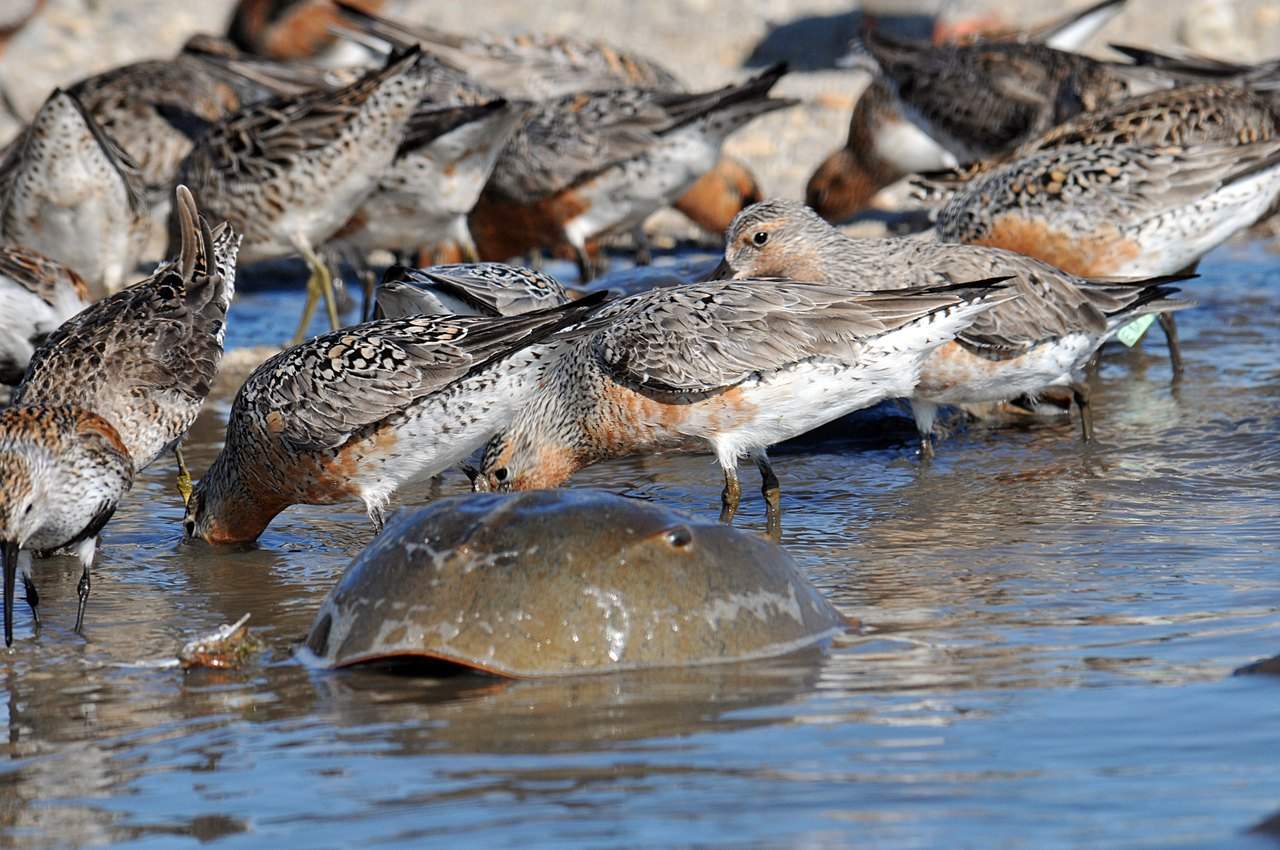
Delaware Bay hosts the largest horseshoe crab spawning population on the planet. That’s not a local boast: the Atlantic States Marine Fisheries Commission confirms it. For a few weeks each spring, Delaware Bay beaches become a staging ground for one of the most consequential wildlife events on the East Coast. The scale is genuinely global. What happens on these beaches determines whether threatened shorebirds survive their migration.
This guide covers when spawning peaks, which Sussex County beaches offer the best access, the shorebird connection, and how to watch without harming the animals. Facts are drawn from DNREC and the Ecological Research and Development Group (ERDG).
Best season: Mid-May through early June, timed to new or full moon high tides, per DNREC
Primary viewing venue: DuPont Nature Center at Mispillion Harbor (observation deck open dawn to dusk daily; center open April to September, days vary by month, per DNREC)
Other Sussex County sites: Slaughter Beach, Broadkill Beach
Fee: Free (beach access and observation deck)
Dogs: Check individual beach rules before visiting; beaches differ
Official source: dnrec.delaware.gov/fish-wildlife/education-outreach/dupont-nature-center/horseshoe-crabs-and-shorebirds/
Last verified: 2026-06
When it happens
Horseshoe crabs move onto Delaware Bay beaches from late April through June, according to DNREC. The best window to see them is May through early June, during any high tide.
Timing your visit around the new or full moon gives you the best odds. DNREC’s official spawning survey targets those lunar windows specifically. Activity peaks around the new and full moon high tides in May and June.
This is an evergreen seasonal event, not a single weekend. If you miss the first full moon of May, there’s another cycle coming.
The red knot connection
The spawning surge matters far beyond the crabs themselves. Migrating shorebirds time their northward flight to arrive on Delaware Bay beaches precisely when horseshoe crab eggs are most abundant.
Those eggs are the reason. According to DNREC, horseshoe crab eggs are packed with protein and fatty acids, making them one of the most efficient foods a shorebird can find. A bird that arrives lean from a long over-water flight can rebuild its fuel reserves faster here than almost anywhere else on the migration route.
The federally-threatened rufa red knot depends on this window. According to DNREC, red knots can double their body weight in about two weeks by gorging on crab eggs. That fat reserve then sustains them for the next leg north.
The migration scope is hard to overstate. According to DNREC’s shorebird program, red knots travel as many as 5,000 miles non-stop. The subspecies that uses Delaware Bay winters at the southern tip of South America and nests in the Canadian Arctic.
Delaware Bay is their final and most critical rest stop before the Arctic leg. After fattening here, they still face a 2,000-mile trip north.
The population trajectory shows what’s at stake. Per DNREC, where nearly 100,000 red knots once made the Delaware Bay stopover, only about 40,000 visited in 2019. The decline tracks closely with fluctuations in horseshoe crab abundance.
Red knots share the beaches with other species in large numbers: ruddy turnstones, sanderlings, and semipalmated sandpipers are all present during peak weeks. For a broader guide to shorebirds and other species in the county, see the Sussex County birding guide.
Where to watch in Sussex County
Several beaches along Delaware Bay are well known for spawning activity. County boundaries matter here. Some of the most-cited locations, including Pickering Beach and Kitts Hummock, are in Kent County, not Sussex. Every fact here links to its official source.
The three accessible options within Sussex County are:
Slaughter Beach is in Sussex County and is one of the primary viewing sites cited by DNREC. The beach fronts directly onto the bay and provides open sightlines during evening high tides.
Mispillion Harbor / DuPont Nature Center sits at the Milford Neck Nature Preserve in Sussex County. The Mispillion River and Cedar Creek meet the Delaware Bay here, per DNREC. According to DNREC, Mispillion Harbor has a gently sloping sandy beach, shallow warming water, and a jetty that protects against wave action. All three conditions are what horseshoe crabs favor.
The DuPont Nature Center operates an observation deck recognized as one of the best vistas on the East Coast for the spring shorebird migration. The center is open April through September, 9 a.m. to 4 p.m., but hours vary by month (Wednesdays and Saturdays only in April and September; Tuesdays through Saturdays in May through August), per DNREC. The accessible observation deck stays open dawn to dusk daily, even when the center is closed.
For shorebirds specifically, DNREC recommends visiting mid-May through the beginning of June, right after a high tide. That’s when birds spread across the exposed beach to feed on freshly deposited eggs.
Broadkill Beach is in Sussex County, on the bay shore beside Prime Hook National Wildlife Refuge. It’s less infrastructure-heavy than the DuPont Nature Center but sits along the same bay shoreline.
If you plan to combine a spawning visit with a full refuge outing, the Prime Hook National Wildlife Refuge guide covers what’s accessible and when. For the county’s other parks and public lands on the bay side, see the Sussex County state parks guide.
Viewing etiquette and flip-a-crab
The event draws people precisely because the crabs come ashore in large numbers. That density also makes it easy to cause harm without realizing it.
Don’t walk across spawning areas or drive on the beach during peak nights. Crabs that are buried or clustered at the waterline can be crushed underfoot.
Keep well back from feeding shorebird flocks. According to DNREC’s shorebird guidelines, stay at least 400 feet away from feeding birds. A flock flushed repeatedly by approaching viewers burns energy it cannot afford to lose: every unnecessary flight costs fuel the bird needed for the Arctic.
Stranded crabs are a direct threat you can actually fix. According to ERDG, beach strandings during spawning cause an estimated 10% of adult horseshoe crab deaths. Heat exposure, oxygen stress, and gulls targeting overturned animals are the main causes. Horseshoe crabs that get flipped onto their backs can’t always right themselves.
The technique, from ERDG’s “Just Flip ‘Em!” program: hold the front edge of the shell and flip the crab back toward the water. Don’t pick up by the tail spine. The tail is a steering tool, not a handle, and grabbing it can injure the animal.
Why it matters beyond one crab: horseshoe crabs take nine to eleven years to reach sexual maturity, according to ERDG. An adult lost to a preventable stranding is years of reproduction lost with it.
Pairing it with a refuge visit
Prime Hook National Wildlife Refuge is on the Delaware Bay side of Sussex County. It’s one of the region’s best birding locations through the spring migration window. A horseshoe crab viewing trip during peak May tides pairs naturally with a morning at the refuge. Shorebirds, warblers, and waterfowl are all active at the same time.
The Prime Hook Wildlife Refuge guide covers trail access, parking, and what to expect by season. The Sussex County birding guide maps bay-side and inland locations by season and species group.
Frequently asked questions
When do horseshoe crabs spawn on Delaware Bay?
Spawning runs from late April through June, according to DNREC. The highest activity is concentrated in May and early June, timed around the new and full moon high tides. For shorebird watching at the same time, the best window is mid-May through early June, right after a high tide.
Which Delaware Bay viewing beaches are in Sussex County?
The confirmed Sussex County sites are Slaughter Beach, Mispillion Harbor (at the DuPont Nature Center), and Broadkill Beach. Several other well-known spawning beaches, including Pickering Beach and Kitts Hummock, are in Kent County, north of the Sussex County line. If you’re traveling specifically for the crabs, confirm county location before driving. The bay beaches here are spread across a long stretch of coastline.
Why do shorebirds depend on horseshoe crab eggs?
During migration, shorebirds like the red knot arrive on Delaware Bay after long, non-stop over-water flights with depleted energy reserves. Horseshoe crab eggs are calorie-dense, high in protein and fatty acids, and available in enormous quantities on the beach surface during spawning. A red knot can rebuild its fat reserves fast enough here to complete the final leg to the Arctic.
According to DNREC’s shorebird program, Delaware Bay is the last critical refueling stop before the Arctic on the red knot’s spring migration.
What is “Just Flip ‘Em” and how do you help a stranded horseshoe crab?
The program from ERDG encourages visitors to right horseshoe crabs that have been overturned and can’t right themselves. Hold the front of the shell (the broad rounded part) and flip the crab so its legs touch the sand, oriented toward the water. Don’t lift by the tail spine.
Strandings account for an estimated 10% of adult deaths per spawning season. Flipping a crab is one of the few hands-on actions a visitor can take that demonstrably helps.
Can you watch the horseshoe crab spawning at Prime Hook?
Prime Hook National Wildlife Refuge is in Sussex County on the Delaware Bay side. Its beach access for spawning observation is more limited than Slaughter Beach or the DuPont Nature Center at Mispillion Harbor. The refuge is excellent for daytime birding during the same spring window, when shorebirds feed on eggs exposed near the waterline. The Prime Hook Wildlife Refuge guide has current access and trail details.
Photo by Gregory Breese, U.S. Fish and Wildlife Service (public domain).

Last verified: 2026-06.