
Sussex County holds five state parks. Two are ocean beaches, one is a quiet bay park, one is an inland cypress swamp, and one packs in WWII history.
Three have ocean or bay swimming; one banned it in 2000; one never built a beach.
This guide compares what each park is for: camping, swimming, dogs and signature features, every fact linked to its official page. Sussex County’s best outdoor spots are public land; you just need to know they exist.
Scan the table, check the Quick Answers, then read the card for whichever park fits your day.
Jump to a park or section
Park directory: quick comparison
| Park | Best for | Signature feature |
|---|---|---|
| Ocean-beach parks | ||
| Cape Henlopen | Full-day beach + history | WWII Fort Miles + Great Dune |
| Delaware Seashore | Ocean, bay + watersports | Indian River Inlet + Life-Saving Station |
| Quiet bay park | ||
| Holts Landing | Crabbing + kayaking | 220-ft crabbing pier (no swimming) |
| The other ocean beach | ||
| Fenwick Island | Undeveloped ocean + bay | “The Quiet Beach” + WWII tower |
| Inland cypress park | ||
| Trap Pond | Paddling + camping | Northernmost natural bald cypress |
How to use: the gray rows are the categories, in the same order as the sections below. The cards add camping, swimming, dogs and sources to each park.
Quick Answers
- Best for ocean swimming: Cape Henlopen, Delaware Seashore and Fenwick Island all have ocean beaches; Cape Henlopen and Delaware Seashore are lifeguarded.
- No swimming: Holts Landing has no beach (it’s a bay park for crabbing and kayaking), and Trap Pond closed its swimming beach permanently in 2000.
- Camping: Cape Henlopen, Delaware Seashore and Trap Pond have campgrounds; Trap Pond adds cabins and yurts; Holts Landing has three wilderness campsites.
- First visit to the county: start with Cape Henlopen for the widest mix of beach, trails and WWII history.
- Want quiet: Holts Landing (bay) and Fenwick Island (“The Quiet Beach”) are the undeveloped, low-crowd options.
The two ocean-beach parks
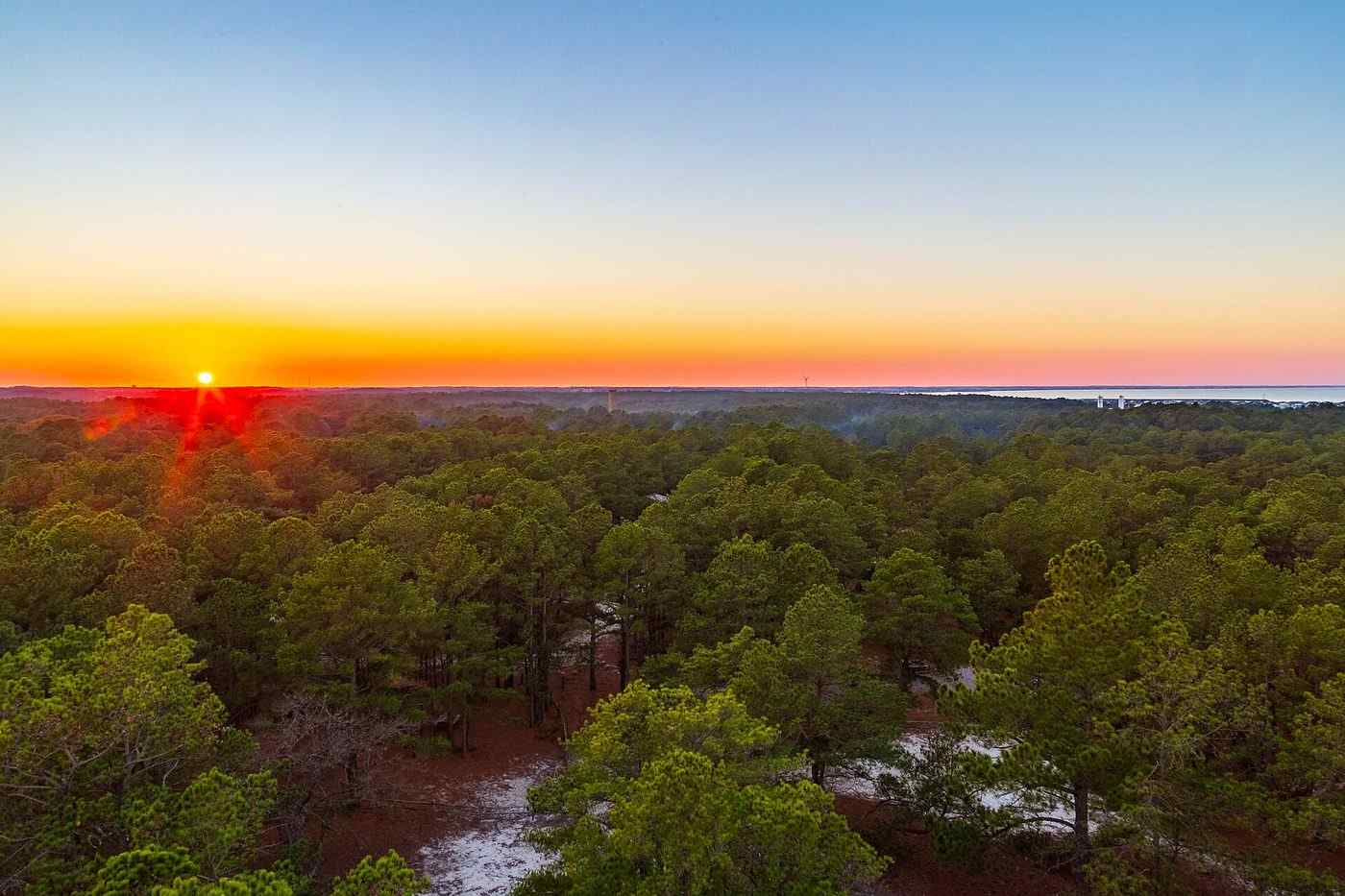
These are the two parks you go to for ocean swimming and the broadest range of activities.
Cape Henlopen State Park
The quick take: the county’s flagship, 5,450 acres of dunes, WWII bunkers and two lifeguarded swimming beaches near Lewes.
- 5,450.81 acres, established 1964 | two swim beaches with lifeguards Memorial Day through Labor Day, beach open year-round | bathhouse and snack bar
- Camping: over 150 sites March 1 to November 30, reservations required, plus a primitive youth campground
- Bay fishing pier (24 hours, year-round) and surf-fishing beach access with a permit
- Dogs: a current policy isn’t stated in the official sources obtained, so check the park page before you bring one
Best for: a full day with swimming, history and trails. Skip if: you want solitude; this is the busy one.
The land has deep public roots. William Penn decreed Cape Henlopen public in 1682, per Wikipedia’s Cape Henlopen entry. That made it one of the first public-use parcels in the Thirteen Colonies.
Its signature draw is the Fort Miles WWII historic area: a gun battery with six barracks and fire control towers. It’s been on the National Register of Historic Places since 2004, per the Fort Miles record.
The 80-foot Great Dune, the Seaside Nature Center’s marine aquariums, and a disc golf course round out the park. It also marks the eastern terminus of the American Discovery Trail.
Hikers can pick up the boardwalk-and-stone Gordons Pond Trail, one of the routes in our guide to hiking in Sussex County. Current fees and hours are on the official Delaware State Parks page.
Delaware Seashore State Park
The quick take: a six-mile barrier strip of ocean and bay near Dewey Beach, built around the Indian River Inlet and a marina.
- 2,722.87 acres, created 1965 as Indian River State Park, renamed 1967 | two lifeguarded ocean swim areas with bathhouses and umbrella, chair and raft rentals
- Tent and RV camping | Indian River Marina, boat launch, surf fishing, windsurfing, sailing, clamming and crabbing
- A dedicated surfing beach sits north of the inlet
- Dogs: a current policy isn’t stated in the official sources obtained, so check the park page
Best for: ocean and bay in one park, watersports, and camping near the beach towns. Skip if: you want shade or forest; this is open barrier-strip terrain.
The park’s standout history is the Indian River Life-Saving Station, established in 1876 and now run as a Delaware State Parks museum. It’s been on the National Register since 1976, per the Life-Saving Station record.
The other anchor is the Indian River Inlet itself, stabilized by jetties in 1939, per Wikipedia’s Delaware Seashore entry. Calm bay water on Rehoboth and Indian River Bay makes it a paddling option too, covered in our Sussex County paddling guide.
Fee details are on the official park page.
The quiet bay park
One park sits alone here, and it’s the small, no-swimming-beach one.
Holts Landing State Park
The quick take: a small, quiet bay park on the south shore of Indian River Bay built for crabbing and kayaking, with no swimming beach.
- 205.6 acres, opened 1965 (land bought from the Holt family in 1957), managed in conjunction with Fenwick Island
- 220-foot crabbing pier (built 2001, open 24 hours, also for fishing) | two-lane boat ramp rebuilt in 2016, the only public boat and kayak access on the south shore between Millsboro and Indian River Inlet
- 3.1 miles of trails and three 20-acre wilderness campsites in the forest
- Dogs: a current policy isn’t stated in the official sources obtained, so check the park page
Best for: crabbing, launching a kayak on Indian River Bay, a quiet picnic. Skip if: you came to swim; there’s no beach, so head to Fenwick or Delaware Seashore.
The purpose-built crabbing pier is the draw. The quieter curiosity is the hand-dug 1890s Assawoman Canal. It still runs through the park but is no longer navigable by motorboat, now popular with kayakers instead, per Wikipedia’s Holts Landing entry.
The Sea Hawk and Seahorse trails here are walked in our hiking guide. The bay launch and the canal feature in our paddling guide. Fees and rules are on the official park page.
The other ocean beach: “The Quiet Beach”
The county’s fifth coast access is an ocean beach too, but an undeveloped one.
Fenwick Island State Park
The quick take: a largely undeveloped ocean-and-bay strip between Ocean City, Maryland and South Bethany that DNREC calls “The Quiet Beach.”
- 375.47 acres, established 1966 (originally the southern part of Delaware Seashore, renamed 1981), managed with Holts Landing
- Day-use ocean beach open for swimming and surfing, with surf fishing on the ocean side
- Bay-side fishing, crabbing, clamming, sailing, windsurfing and kayaking on Little Assawoman Bay
- Dogs: a current policy isn’t stated in the official sources obtained, so check the park page
Best for: ocean swimming or surfing away from the crowds, plus calm bay-side paddling. Skip if: you want full facilities; this is the undeveloped one.
A WWII-era observation tower still stands at the north end. It’s a reminder this strip was used for coastal defense, per Wikipedia’s Fenwick Island entry.
The land carries old names. It’s named for Thomas Fenwick, who was granted rights by Lord Baltimore in 1682. The Trans-Peninsular Line marking Delaware’s southern boundary begins here.
The calm Little Assawoman Bay side is a paddling spot, noted in our paddling guide.
For swimming details and current fees, see the official park page.
The inland cypress park
The only park here that isn’t on the coast is also the most distinctive.
Trap Pond State Park
The quick take: Delaware’s first state park, inland near Laurel, built around a 90-acre former millpond that holds the northernmost natural stand of bald cypress in the United States.
- 3,993.28 acres, established June 22, 1951, the first state park in Delaware
- No swimming: the sandy beach closed permanently on May 17, 2000
- Boating concession rents canoes, kayaks, rowboats and pedal boats, with a launch ramp for shallow-draft boats | fishing for crappie, bluegill, bass and pickerel
- Camping with RV sites, tent sites, cabins and yurts, the widest range of the five
- Dogs: a current policy isn’t stated in the official sources obtained, so check the park page
Best for: paddling among cypress, camping in a cabin or yurt, and birding for bald eagles, pileated woodpeckers and herons. Skip if: you specifically want to swim; there’s been none since 2000.
The headline fact is the cypress itself. The 90-acre pond was dammed by 18th-century lumbermen to power a sawmill. It now anchors the northernmost natural stand of bald cypress in the United States, per the National Park Service.
The 4.5-mile Bob Trail circles the swamp, covered in our hiking guide. The Bald Cypress Nature Center runs naturalist-led pontoon tours among the trees, described in our paddling guide.
The full park profile is in Wikipedia’s Trap Pond entry. Fees and camping are on the official park page.
Before you go
Four things change often enough to check every time.
Fees. All five are Delaware state parks and charge a seasonal vehicle entrance fee that varies by residency. Current rates are on the official Delaware State Parks site.
Swimming. Only Cape Henlopen, Delaware Seashore and Fenwick Island have it.
Rules differ park by park. Check the one you’re visiting, not the one you visited last.
Holts Landing has no beach, and Trap Pond closed its beach in 2000, so don’t plan a swim at either.
Dogs. A current dog or pet policy isn’t stated in the official sources obtained for these parks. Check each park’s own rules on the official page before you bring a dog. Don’t assume the policy carries over from a neighboring park.
Camping. Cape Henlopen, Delaware Seashore and Trap Pond have campgrounds. Trap Pond also adds cabins and yurts, the widest range of the five.
Holts Landing has three wilderness campsites. Camping isn’t confirmed for Fenwick Island, so check its page if that matters.
Seasons. Timing is half the reward here.
The shoulder seasons are when this county is at its best.
Cape Henlopen’s campground runs March 1 to November 30, and horseshoe crabs come ashore in spring.
Frequently asked questions
Which Sussex County state parks have swimming?
Cape Henlopen, Delaware Seashore and Fenwick Island have ocean swimming, and Cape Henlopen and Delaware Seashore have lifeguarded beaches in season. Holts Landing has no swimming beach, and Trap Pond’s beach closed permanently in 2000.
Which Sussex County state park is best for camping?
Three offer it: Cape Henlopen (150+ sites, March to November), Delaware Seashore (tent and RV), and Trap Pond (tent, RV, cabins and yurts). Trap Pond has the widest range. Holts Landing has three wilderness campsites.
Where can you see bald cypress trees in Delaware?
At Trap Pond State Park near Laurel. It holds the northernmost natural stand of bald cypress in the United States, reached by the Bob Trail or naturalist-led pontoon tours.
Which is the quietest Sussex County state park?
Holts Landing is a small, undeveloped bay park, and DNREC calls Fenwick Island “The Quiet Beach.” Both are the low-crowd alternatives to Cape Henlopen and Delaware Seashore.
Do Sussex County state parks charge an entrance fee?
Yes. All five are Delaware state parks and charge a seasonal vehicle entrance fee that varies by residency. Current rates are on the official Delaware State Parks site.
Photos: Acroterion (CC BY-SA 4.0) and Andrew Parlette (CC BY 2.0), via Wikimedia Commons.


More on the county’s parks and free spots: the first-timer’s guide to Cape Henlopen, the Prime Hook refuge visitor guide, a side-by-side of the three bay parks, and the roundup of free outdoor activities in the county.
Last verified: 2026-06.