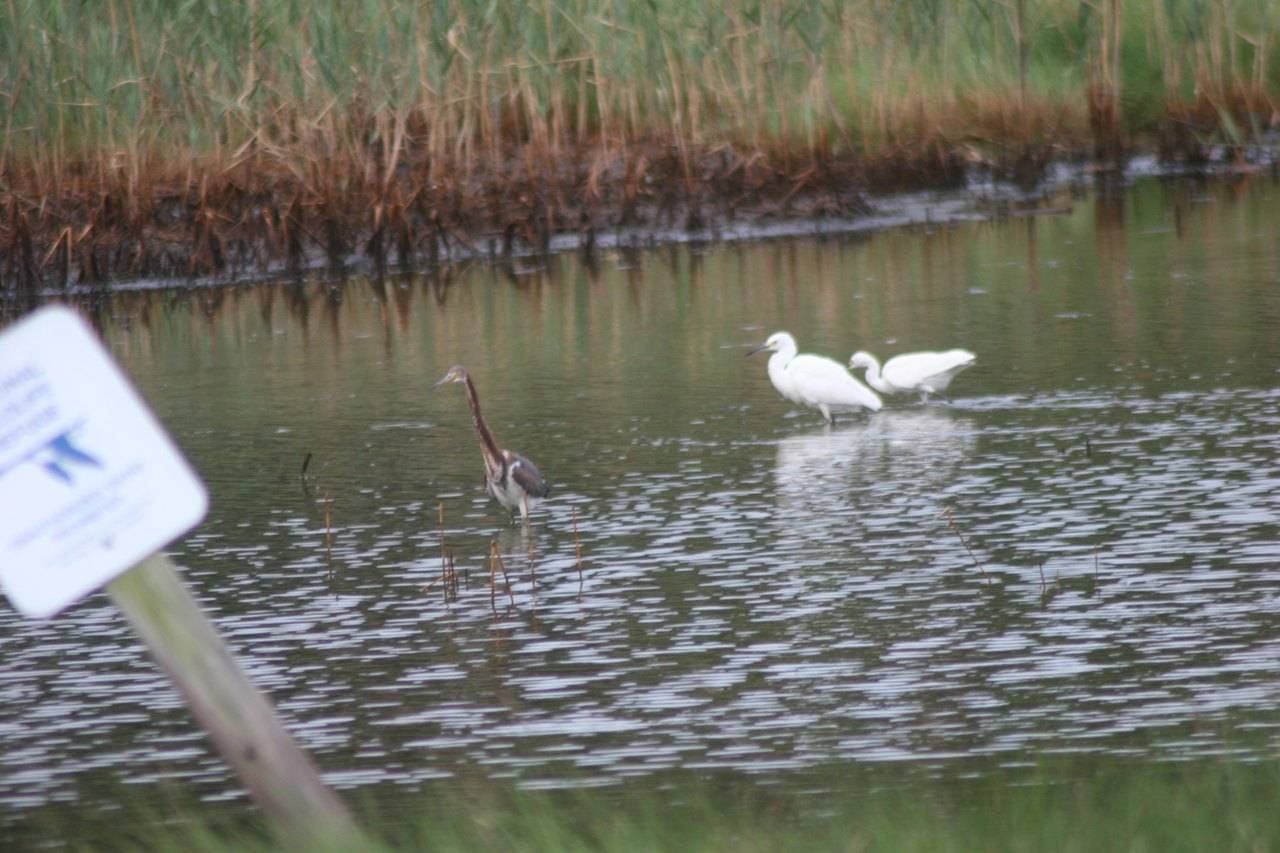
Delaware is recognized internationally as the Shorebird Capital of the world, according to the Delaware Birding Trail.
Sussex County is where most of that reputation is earned.
The county sits squarely on the Atlantic Flyway, and what you’ll see changes completely from one season to the next.
Snow geese pack the wetlands through winter. Red knots descend on the bay beaches each May to fuel up on horseshoe crab eggs.
Migrant songbirds and terns take the coast in spring and fall. Year-round, the cypress swamp at Trap Pond holds woodpeckers, herons, and nesting eagles.
One note on geography: Bombay Hook National Wildlife Refuge is Delaware’s most famous birding site, but it lies in Kent County, not Sussex. Every spot in this guide is within Sussex County.
This overview maps the top spots, links to the official sources for each, and connects to the deep-dive articles on the county’s two signature spectacles.
Jump to a section
Best spots at a glance
| Spot | Signature birds | Best season |
|---|---|---|
| Bayshore wetlands | ||
| Prime Hook NWR | Snow geese, waterfowl, shorebirds | Late fall through spring |
| The coast | ||
| Cape Henlopen State Park | Migrants, terns, piping plovers | Spring + fall migration |
| Delaware Seashore + inland bays | Ospreys, waterfowl | Spring to fall / winter |
| Inland | ||
| Trap Pond State Park | Woodpeckers, herons, bald eagles | Year-round |
| Delaware Bay beaches | ||
| Bay stopover beaches | Red knots + shorebirds | May to June |
How to use: gray rows are the regions, in the same order as the sections below. Cards add access details, sources, and seasonal timing.
Quick Answers
- Best winter birding: Prime Hook NWR, where snow geese and other waterfowl concentrate from late fall into spring.
- Best spring shorebird event: the Delaware Bay beaches in May and early June, for red knots and the horseshoe crab spectacle; the full account is in the horseshoe crab and shorebird guide.
- Best year-round spot: Trap Pond State Park, with bald eagles, herons, and woodpeckers in every season.
- Most accessible birding: Prime Hook’s Dike Trail (0.49 mi, hard surface to a wheelchair-accessible platform) and the Boardwalk Trail (0.55 mi loop, 600 feet of freshwater marsh), both free. The full list is in the accessible trails guide.
- Free birding: Prime Hook NWR is open daily at no charge, from a half hour before sunrise to a half hour after sunset.
Prime Hook National Wildlife Refuge
Prime Hook is the county’s premier birding destination. The refuge provides important habitat to over 245 species of birds, according to USFWS.
More than 10,000 acres, roughly 80 percent wetlands, sit along the western shore of Delaware Bay, stretching from Slaughter Beach in the north to the Broadkill River in the south, per the USFWS refuge page.
The refuge was established in 1963 under the Migratory Bird Conservation Act as an inviolate sanctuary for migratory birds. USFWS describes it as a globally renowned place for nature photography and birding.
Snow geese are the signature winter draw, arriving in late fall and staying through early spring. USFWS focus species at the refuge include the Rufa Red Knot, Snow Goose, and Least Tern, per the species page.
The snow geese have their own deep-dive guide.
Access is practical for all levels. You can drive four county roads that cross the refuge’s marshes, or walk 7.5 miles of trails, per USFWS.
The Boardwalk Trail (0.55 mi loop) crosses 600 feet of freshwater marsh on boardwalk. The Dike Trail (0.49 mi) runs to a wheelchair-accessible observation platform.
A word on timing: USFWS warns that mosquitoes, ticks, and biting flies can be very high from June through September. Fall, winter, and spring are the comfortable windows for a long visit.
Fowler Beach is currently closed through nesting season to protect federally threatened piping plovers and state endangered least terns, per the refuge page. It reopens October 1.
The full Prime Hook guide covers access, trails, and seasonal highlights in detail.
Cape Henlopen State Park
Cape Henlopen is site 16 on the Delaware Birding Trail, a 27-site circuit created by Delaware Audubon, the Delmarva Ornithological Society, DNREC, and USFWS.
Three endangered species nest here: the black skimmer, the least tern, and the piping plover, per Wikipedia’s Cape Henlopen entry.
The park’s Gordons Pond area is the reason birders come back. Gordons Pond borders a 900-acre saltwater lagoon that Delaware Greenways identifies as one of only four waterfowl migration superhighways in North America.
The trail skirting the pond draws waterfowl throughout fall, winter, and spring migration seasons, per TrailLink. Osprey nests and bald eagles occupy the pine and oak trees along the path.
Spring brings horseshoe crab nesting beaches on the bay side. The Gordons Pond Trail guide has the full access details; the trail fully reopened on May 21, 2026 after repair of high-tide damage, per Delaware Greenways.
The park’s Seaside Nature Center runs birding trips and guided nature walks year-round, per Wikipedia.
Trail sections can close seasonally for shorebird nesting, so checking ahead is worthwhile.
Every fact here links to its official source.
Trap Pond State Park
Trap Pond is the year-round option, and the one with no coastal counterpart.
Bald eagles, pileated woodpeckers, and herons are the birds people come for, per the Wikipedia Trap Pond entry. The freshwater cypress marsh creates habitat you won’t find at the coastal parks.
Pileated woodpeckers are spotted in the cypress marsh, per TrailLink’s Bob Trail page.
Warblers, kingfishers, geese, and herons are regularly spotted along the Bob Trail, per Delaware Greenways. Kingfisher and wood duck calls echo through the water-woods, per the NPS article on the cypress stand.
Trap Pond holds the nation’s northernmost natural stand of bald cypress, per the NPS article on the cypress stand. The bald cypress is a deciduous conifer: the needles turn rust-orange in autumn before dropping, and new growth fills in during late spring.
The cypress grove looks different every month.
Delaware’s first state park, established June 22, 1951, Trap Pond covers nearly 4,000 acres (3,993.28 acres), per Wikipedia.
The Bob Trail’s 4.5-mile loop is the primary birding route; the water trails guide covers the paddling option, which puts you among the herons and eagles at water level.
Delaware Seashore and the inland bays
The three inland bays (Rehoboth Bay, Indian River Bay, and Little Assawoman Bay) are home to hundreds of species, functioning as nurseries for migratory bird populations, per the Center for the Inland Bays.
The bays average only 3 to 8 feet in depth, which concentrates feeding birds along the shallows.
Ospreys are the signature warm-season birds at the bay parks.
The Sea Hawk Trail at Holts Landing (1.3 mi) passes borrow-pit ponds and an osprey meadow, per Wikipedia’s Holts Landing entry.
Further inland, the Nanticoke River watershed has the highest concentration of bald eagles in the northeastern United States, per the Nanticoke River organization.
Bald eagles, osprey, and kingfishers are among the species reported along the Broad Creek paddle route, per Paddle the Nanticoke. Water access to these areas is mapped in the kayaking and canoeing guide.
Delaware Seashore State Park is itself a birding site: site 18 on the Delaware Birding Trail, between Cape Henlopen (#16) and the James Farm Ecological Preserve (#19), per the trail site list.
Waterfowl use the inland bays through winter when the coast quiets down.
Delaware Bay shorebird stopover
Each May and early June, the Delaware Bay beaches draw large numbers of migratory shorebirds feeding on horseshoe crab eggs. The horseshoe crab spawning guide covers the timing and the best Sussex County viewing beaches.
Red knots and other long-distance migrants time their arrival to coincide with horseshoe crab spawning. The crab eggs are the fuel that powers a non-stop flight from South America to the Arctic.
The bay shoreline along Kent and Sussex counties is teeming with hundreds of thousands of migratory shorebirds in both spring and fall, according to the Delaware Birding Trail.
The Rufa Red Knot is a USFWS focus species at Prime Hook, per the species page. The refuge’s annual Horseshoe Crab Festival each May is described as an outdoor recreation highlight of spring in Delaware, per USFWS.
The specifics of timing, access, and what to expect are in the horseshoe crab spawning guide.
A season-by-season calendar
Spring (March to May): migrant songbirds appear first. By May, the bay beaches are the show: red knots and hundreds of thousands of other shorebirds refuel on horseshoe crab eggs, per the Delaware Birding Trail.
Piping plovers and least terns arrive to nest at Cape Henlopen. Osprey return to the inland bays.
Summer (June to August): breeding season at the coast. Black skimmers, least terns, and piping plovers are active; Prime Hook’s Fowler Beach closes during nesting season.
Summer is also the high-bug window at Prime Hook (June through September), so early-morning visits matter. Ospreys are active on the inland bays.
Fall (September to November): hawk migration and the first waves of waterfowl, per the Delaware Birding Trail. Shorebirds pass through in September.
Snow geese begin arriving in late fall and fill Prime Hook. This is also when the cypress at Trap Pond turns rust-orange before dropping its needles.
Winter (December to February): snow geese dominate at Prime Hook and Gordons Pond, from late fall into spring. Bald eagles are active at Trap Pond year-round.
The Nanticoke watershed holds the highest eagle concentration in the northeast. The bay parks hold wintering waterfowl when the shorebirds have gone.
The shoulder seasons are when this county is at its best.
How to bird responsibly
Sussex County’s birding sites are managed habitats where disturbance has real consequences. A few sourced rules apply across the county.
Stay on the trail and respect closures. Fowler Beach at Prime Hook closes for the duration of nesting season to protect federally threatened piping plovers and state endangered least terns, per USFWS.
Sections of the Gordons Pond Trail can close for shorebird nesting as well.
Keep your distance from nesting birds. The three species nesting at Cape Henlopen (piping plover, least tern, black skimmer) are endangered, per Wikipedia.
Approach close enough to flush a nesting bird and you’ve already done damage.
At Prime Hook, dogs are allowed on a short handheld leash. Keep them out of the water near marsh areas where rails and ground-nesting species use the vegetation.
Verified beats vivid: we’d rather be accurate than poetic.
The Delaware Birding Trail was built as a collaborative effort by Delaware Audubon, the Delmarva Ornithological Society, DNREC, and USFWS, per the trail page.
Their site lists which areas on the 27-site circuit have viewing platforms, accessible paths, and parking. Checking site-specific notes before your visit takes two minutes and avoids a wasted trip.
Frequently asked questions
Where is the best birding in Sussex County, Delaware?
Prime Hook National Wildlife Refuge near Milton is the county’s primary birding destination, with over 245 species recorded according to USFWS. Cape Henlopen State Park (site 16 on the Delaware Birding Trail) is the top coastal option, and Trap Pond State Park offers year-round inland birding for eagles, woodpeckers, and herons.
When can you see snow geese in Sussex County?
Snow geese gather at Prime Hook from late fall into spring, with wintering waterfowl at Gordons Pond too. The detailed timing and best viewing spots are covered in the snow geese at Prime Hook guide.
Where can you see red knots and the horseshoe crab shorebird event?
The Delaware Bay beaches in May and early June are the place. The timing window is narrow and tied to horseshoe crab spawning. The horseshoe crab spawning and shorebird guide covers the full event.
Is there accessible (wheelchair or stroller) birding in Sussex County?
Yes. Prime Hook NWR has two short accessible routes, both free: the Dike Trail (0.49 mi, hard surface to a viewing platform) and the Boardwalk Trail (0.55 mi loop), per USFWS.
For a county-wide list of wheelchair and stroller-friendly options, the accessible trails guide covers all sites.
Do you need to pay to go birding in Sussex County?
Prime Hook NWR is free and open daily, per USFWS. Redden State Forest, another Delaware Birding Trail site, is also free.
Delaware State Parks charge a seasonal vehicle entrance fee. Current rates are listed on the Delaware State Parks site.
Photo of shorebirds at Prime Hook NWR, U.S. Fish and Wildlife Service (public domain).
.jpg)
Last verified: 2026-06.